
New Dogsbody from Austin English
I’m out of town so no reviews here today, but there’s a new Dogsbody over at The Comics Journal website. Austin English is a thought provoking mini-comics critic, as well as one of the most interesting mini creators out there. Go read.
Friday, August 19, 2005

Tuesday, August 16, 2005
Two from John Hankiewicz
I’ve been struggling a bit with this post on John Hankiewicz’ work; I’ve read Dance three times and puzzled over exactly what it means to me. I pick it up and it feels reassuring. Inside, I’m not reassured so much as thrilled. But when I try to put my feelings into words, I’m almost lost. Dance has a simple, creamy cover of thick paper that’s bound together by string. On the front is a panel from the mini-comic and the title Dance positioned vertically in reddish letters.
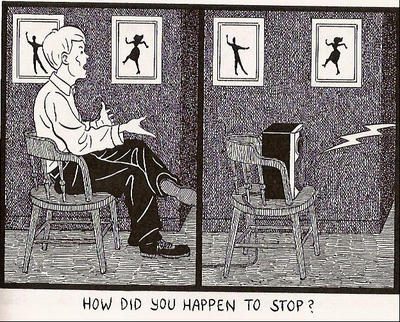
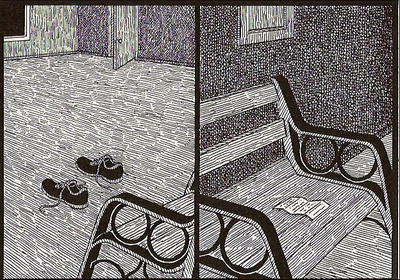
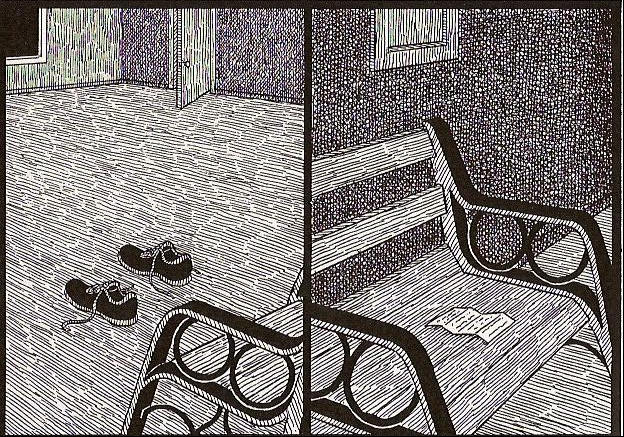
But inside there’s nothing simple. After a brief dance of two lovers discussing a rift in their relationship as they traverse the dance floor, Hankiewicz unleashes an arsenal of pages that flow together seamlessly, while leaving the reader almost struggling to keep up with him. He calls this section “Amateur Comics,” but it feels like he knows what he’s doing with each panel. “Amateur Comics” is a narrative tied together with a series of questions, often repeated, that are accompanied by images of a lone male character reacting to his environment. The environment changes with each new question and the character must adapt to the change from the question asked. There’s a formality to this section, partly because of the starkness of the illustrations, but also because of the pattern that exists. As a reader you travel from room to room with the character, but in the end you’re left by yourself as only his shoes remain. On the last panel, there’s a note on a bench. I want to know what that note says.
The rest of Dance consists of a short sketchbook section of figures from the waist down as they dance and an experimental story called “The Kimball House.” Dance is a 100 page mini-comic, square bound with string and it’s available from John’s website for $9.
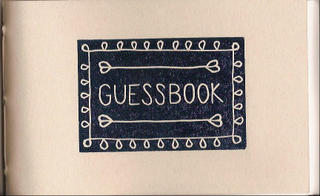
Guessbook is an 88-page sketchbook by John and it’s also bound together with string. This is a time-consuming process, and much more difficult than simply stapling some pages together (my preferred method, because I lack the patience for hand stitching a mini-comic).
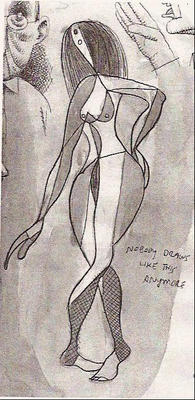
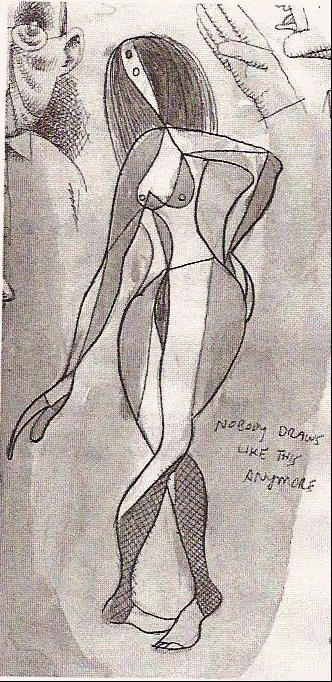
In Guessbook, John switches gears, playing around with caricatures, figure studies, gags, and still life drawings. Like the Martin Cendreda sketchbook, it’s interesting to see an artist stretch their legs a bit and play with the form that they adhere to in their usual work. Hankiewicz’ figures and backgrounds are very regimented in his normal work, but here he draws with a much looser hand. It’s fun watching him take a character and deconstruct the familiar. Sometimes you’re left with a cubist sketch as in this drawing where John notes, “Nobody draws like this anymore.”
I urge you to check out John’s website and his comics. His is a unique vision and I haven’t even talked about Tepid and Martha/Gregory yet.
I’ve been struggling a bit with this post on John Hankiewicz’ work; I’ve read Dance three times and puzzled over exactly what it means to me. I pick it up and it feels reassuring. Inside, I’m not reassured so much as thrilled. But when I try to put my feelings into words, I’m almost lost. Dance has a simple, creamy cover of thick paper that’s bound together by string. On the front is a panel from the mini-comic and the title Dance positioned vertically in reddish letters.
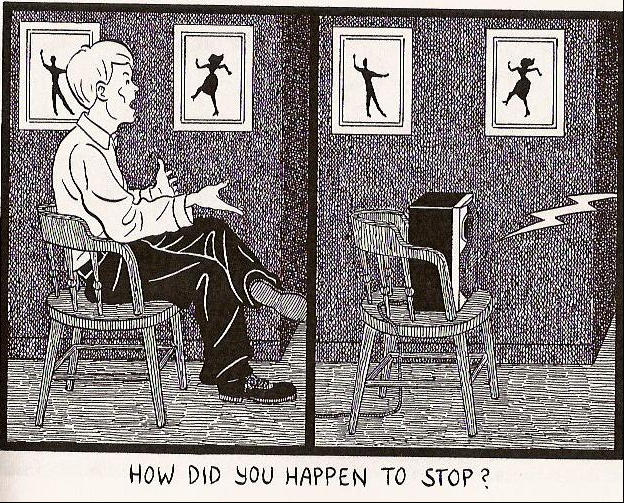
But inside there’s nothing simple. After a brief dance of two lovers discussing a rift in their relationship as they traverse the dance floor, Hankiewicz unleashes an arsenal of pages that flow together seamlessly, while leaving the reader almost struggling to keep up with him. He calls this section “Amateur Comics,” but it feels like he knows what he’s doing with each panel. “Amateur Comics” is a narrative tied together with a series of questions, often repeated, that are accompanied by images of a lone male character reacting to his environment. The environment changes with each new question and the character must adapt to the change from the question asked. There’s a formality to this section, partly because of the starkness of the illustrations, but also because of the pattern that exists. As a reader you travel from room to room with the character, but in the end you’re left by yourself as only his shoes remain. On the last panel, there’s a note on a bench. I want to know what that note says.
The rest of Dance consists of a short sketchbook section of figures from the waist down as they dance and an experimental story called “The Kimball House.” Dance is a 100 page mini-comic, square bound with string and it’s available from John’s website for $9.
Guessbook is an 88-page sketchbook by John and it’s also bound together with string. This is a time-consuming process, and much more difficult than simply stapling some pages together (my preferred method, because I lack the patience for hand stitching a mini-comic).

In Guessbook, John switches gears, playing around with caricatures, figure studies, gags, and still life drawings. Like the Martin Cendreda sketchbook, it’s interesting to see an artist stretch their legs a bit and play with the form that they adhere to in their usual work. Hankiewicz’ figures and backgrounds are very regimented in his normal work, but here he draws with a much looser hand. It’s fun watching him take a character and deconstruct the familiar. Sometimes you’re left with a cubist sketch as in this drawing where John notes, “Nobody draws like this anymore.”
I urge you to check out John’s website and his comics. His is a unique vision and I haven’t even talked about Tepid and Martha/Gregory yet.
Sunday, August 14, 2005
Flytrap by Sara Ryan (words) and Steve Lieber (art)
Hmm, I’ve watched the positive reviews flowing in on this mini-comic, as it's moved closer to the top of my review pile. It’s at the top of the pile now, and I’m struggling with what to add to what’s already been written. Everyone loves this mini and now I know why.
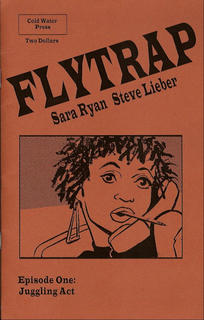
Flytrap Episode One: Juggling Act is a stand alone tale in sixteen pages and it reads like a sudden summer storm. The story comes at you from out of nowhere and it immediately grabs your attention. Main character Maddy is a public relations specialist with a personal life that’s threatening to overwhelm her. In fact, it only takes sixteen pages for her life to turn upside down. What’s interesting here is how much you learn about Maddy as events unfold around her; this is character development on the sly. Sara Ryan has a firm hand on the story and Maddy’s character, and we learn just enough about her to want to know more.
Maddy loses her car, her boyfriend and her job. Yet, she’s about to strike out on her own and she’ll be the PR director for the mysterious Flytrap circus. Maddy as a character is one you root for even though you've just met her. She bends but never breaks, and you just know she'll find a way to recover from all the bad things that have happened in her life recently.
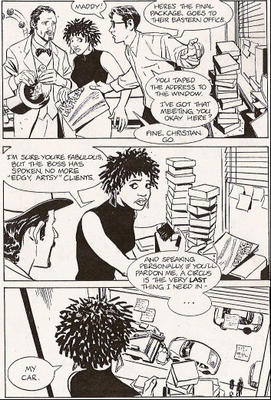
The art from Steve Lieber is almost too self-assured for a mini-comic, but it works here. He uses several visual tricks that reveal his command and experience with pencil and ink. While reading Flytrap, you feel like you're looking at something published by a smaller publisher, but format is still mini-comic. I would recommend this for someone unsure of the mini-comic format, because the style is similar enough to a regular comic that it won't be too much of a shock to the system. It's $2 including shipping for the first issue and it's available from Sara or Steve's website.
Hmm, I’ve watched the positive reviews flowing in on this mini-comic, as it's moved closer to the top of my review pile. It’s at the top of the pile now, and I’m struggling with what to add to what’s already been written. Everyone loves this mini and now I know why.

Flytrap Episode One: Juggling Act is a stand alone tale in sixteen pages and it reads like a sudden summer storm. The story comes at you from out of nowhere and it immediately grabs your attention. Main character Maddy is a public relations specialist with a personal life that’s threatening to overwhelm her. In fact, it only takes sixteen pages for her life to turn upside down. What’s interesting here is how much you learn about Maddy as events unfold around her; this is character development on the sly. Sara Ryan has a firm hand on the story and Maddy’s character, and we learn just enough about her to want to know more.
Maddy loses her car, her boyfriend and her job. Yet, she’s about to strike out on her own and she’ll be the PR director for the mysterious Flytrap circus. Maddy as a character is one you root for even though you've just met her. She bends but never breaks, and you just know she'll find a way to recover from all the bad things that have happened in her life recently.

The art from Steve Lieber is almost too self-assured for a mini-comic, but it works here. He uses several visual tricks that reveal his command and experience with pencil and ink. While reading Flytrap, you feel like you're looking at something published by a smaller publisher, but format is still mini-comic. I would recommend this for someone unsure of the mini-comic format, because the style is similar enough to a regular comic that it won't be too much of a shock to the system. It's $2 including shipping for the first issue and it's available from Sara or Steve's website.
Thursday, August 11, 2005
Mr. Big #4 by Matt Dembicki and Carol Ault Dembicki
Issue number four of Mr. Big is here and Matt writes that he hopes to have issue five out by SPX. Let’s hope so, because the world needs more Mr. Big.
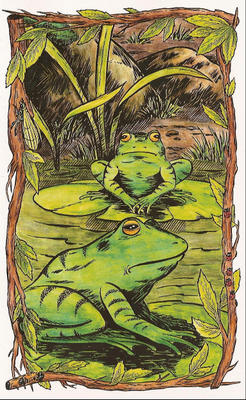
Mr. Big is a snapping turtle that lives in a pond. He terrorizes the other animals of the pond and they’ve secretly began plotting a way to get rid of him. This issue it winds up in the hands of the crows, who circle overhead watching everyone else as they go about their business. In this installment, the frogs are discussing Mr. Big and the crows’ decision – or lack of a decision.
If you’ve never read Mr. Big, go check out Wasp Comics.com, where you can read previous issues online. I still remember my first issue of Mr. Big. All of the pond animals were kind of cruising along peacefully at the beginning of spring; it was a very peaceful, almost Zen mini-comic. A mamma duck was floating across the surface of the pond with a few of her ducklings. But then it was a upshot of the ducks little bottoms floating in the water. “Oh shit,” I thought, “Who’s Mr. Big and is he the one that’s looking up at the ducklings?” Then, next panel there were little duck feathers lingering in the air, as the surface of the pond is all ripples and quiet. Crap, so much for a peaceful spring.
Issue two was a “night issue” that’s probably one of my favorite issues, you can check it out online too, but you should just give Matt a shout at m@waspcomics.com and ask him to send you paper copies of Mr. Big issues 1-4.
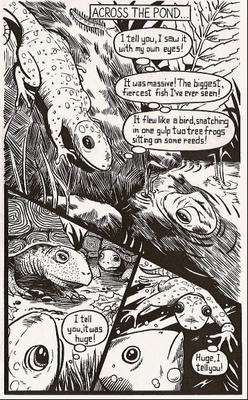
Back to issue four though. Matt and Carol have done something unique in this series by focusing on a pond and the creatures that inhabit it. Mr. Big is both adventure and soap opera, it just needs to come out more often. Issue four ends with no resolution, but being a transplanted Maryland/DC guy, I think I know where they are heading with the new threat that’s just barely introduced in the last few pages of this issue. Issue five by SPX, Matt and Carol. C’mon get to work.
Mr. Big issue four is $1.50 and available by emailing Matt at m@waspcomics.com. The cover is in color, but if I had to have a beef with them, it would be that they need a logo for this series. Nothing fancy, just a Mr. Big across the top or bottom to let readers know what’s up. This is only an issue if you’re going to be sitting on the racks at a comics shop, I guess, but I kind of miss a logo.
Issue number four of Mr. Big is here and Matt writes that he hopes to have issue five out by SPX. Let’s hope so, because the world needs more Mr. Big.
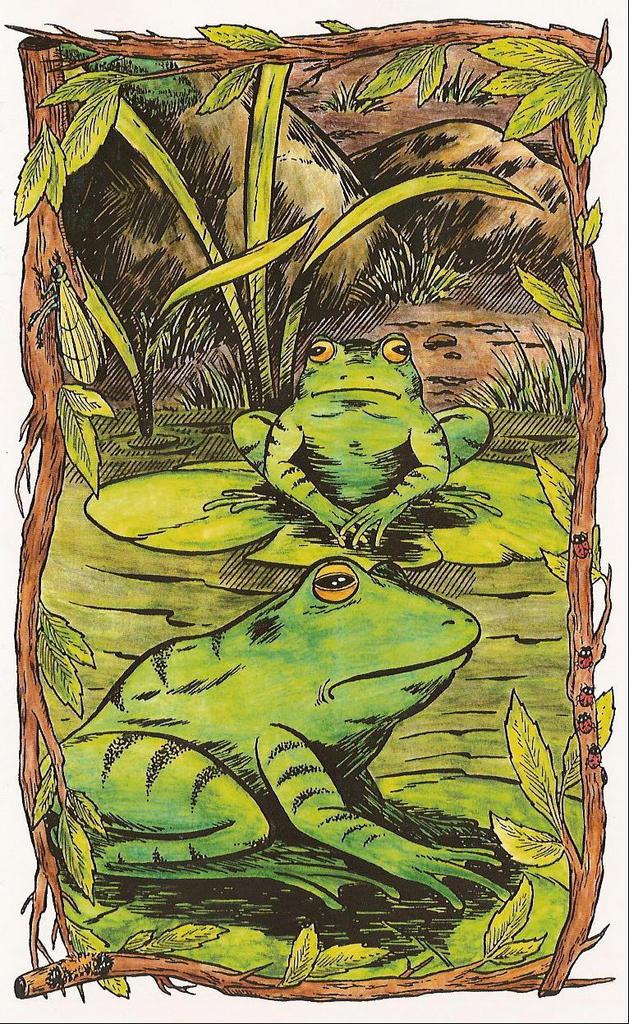
Mr. Big is a snapping turtle that lives in a pond. He terrorizes the other animals of the pond and they’ve secretly began plotting a way to get rid of him. This issue it winds up in the hands of the crows, who circle overhead watching everyone else as they go about their business. In this installment, the frogs are discussing Mr. Big and the crows’ decision – or lack of a decision.
If you’ve never read Mr. Big, go check out Wasp Comics.com, where you can read previous issues online. I still remember my first issue of Mr. Big. All of the pond animals were kind of cruising along peacefully at the beginning of spring; it was a very peaceful, almost Zen mini-comic. A mamma duck was floating across the surface of the pond with a few of her ducklings. But then it was a upshot of the ducks little bottoms floating in the water. “Oh shit,” I thought, “Who’s Mr. Big and is he the one that’s looking up at the ducklings?” Then, next panel there were little duck feathers lingering in the air, as the surface of the pond is all ripples and quiet. Crap, so much for a peaceful spring.
Issue two was a “night issue” that’s probably one of my favorite issues, you can check it out online too, but you should just give Matt a shout at m@waspcomics.com and ask him to send you paper copies of Mr. Big issues 1-4.
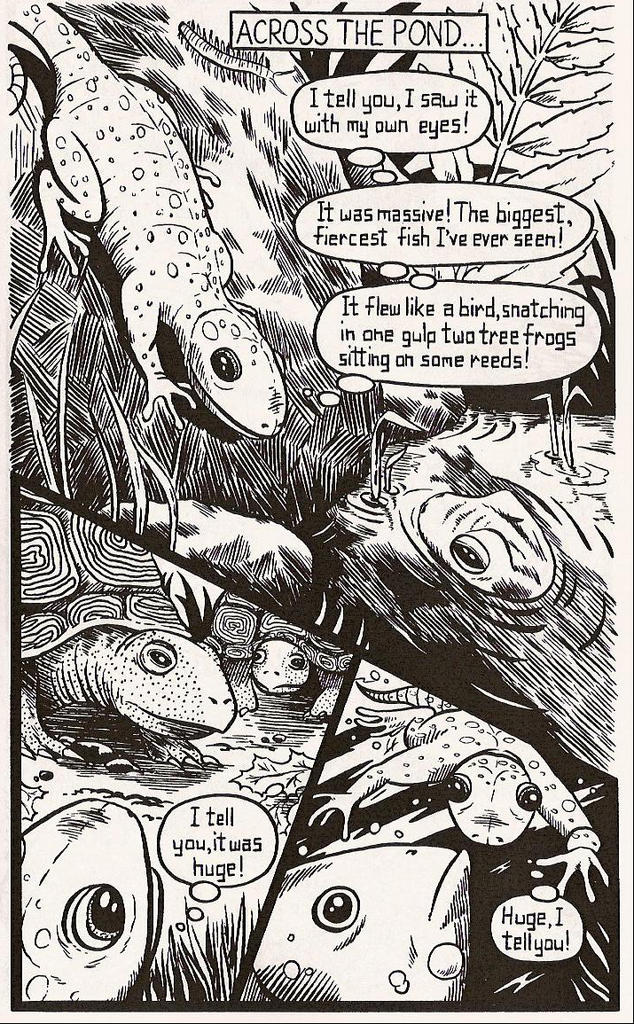
Back to issue four though. Matt and Carol have done something unique in this series by focusing on a pond and the creatures that inhabit it. Mr. Big is both adventure and soap opera, it just needs to come out more often. Issue four ends with no resolution, but being a transplanted Maryland/DC guy, I think I know where they are heading with the new threat that’s just barely introduced in the last few pages of this issue. Issue five by SPX, Matt and Carol. C’mon get to work.
Mr. Big issue four is $1.50 and available by emailing Matt at m@waspcomics.com. The cover is in color, but if I had to have a beef with them, it would be that they need a logo for this series. Nothing fancy, just a Mr. Big across the top or bottom to let readers know what’s up. This is only an issue if you’re going to be sitting on the racks at a comics shop, I guess, but I kind of miss a logo.
Wednesday, August 10, 2005
A pair of minis from Marcos Perez
There are a lot of mini-comics that have found their way to the SIZE MATTERS offices, and I’m starting to make a dent in them. I need to be caught up before SPX though, so I’ll continue loading new minis every other day. Maybe every day if stuff keeps coming in.
Today is Marcos Perez day. Marcos sent in his Carl is The Awesome Vol. 1 and Mercury Lounge.
Carl is The Awesome Vol. 1 is pretty awesome for what it is, and that’s a collection of four short minis tucked into a little sleeve. It’s not just a mini-comic. It’s four mini comics – in a little sleeve!
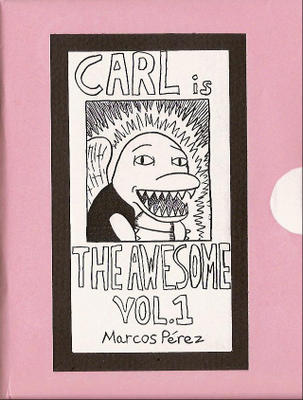
Carl is a dinosaur with a tail like a beaver. He’s about four feet tall, kind of pudgy and he is awesome. Or he thinks he’s awesome and he wants every one to know that he is. That’s the set-up. Issue one is an introduction of sorts to Carl. He says things like, “I have strong haunches and very sturdy teeth!!! My body is rugged like corduroy!” and “Ladies demand my sexuals!!” That’s Carl and that’s all you need to know to get started. In issue two, he introduces you to his band “The Supersicks,” and explains how they make their songs and all the rock star stuff they include on their rider.
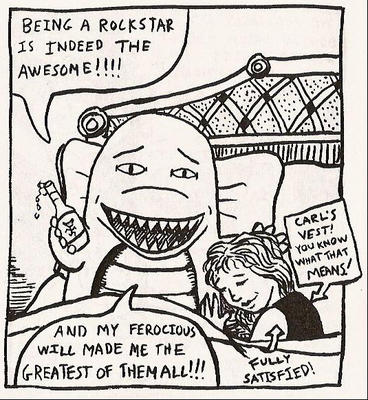
Issue three of Carl is The Awesome Vol. 1 is a informal lesson on how to score with the ladies. Carl explains how to make eye contact, select an opening line, how to navigate a conversation with a lady, how to kiss and when to use “C’mon!!” Issue four is the Carl runs for public office issue. Let’s put it this way, he’s an interesting debater.
Each of the four issues are eight, usually single panel pages, including the covers. The back cover counts as the last panel of the story. Carl is The Awesome Vol. 1 is $2 and you can get your copies at Cliff Face Comics. Perez is kind enough to have the first issue of Carl’s adventures on the website in color. GO check it out; you know you want to.
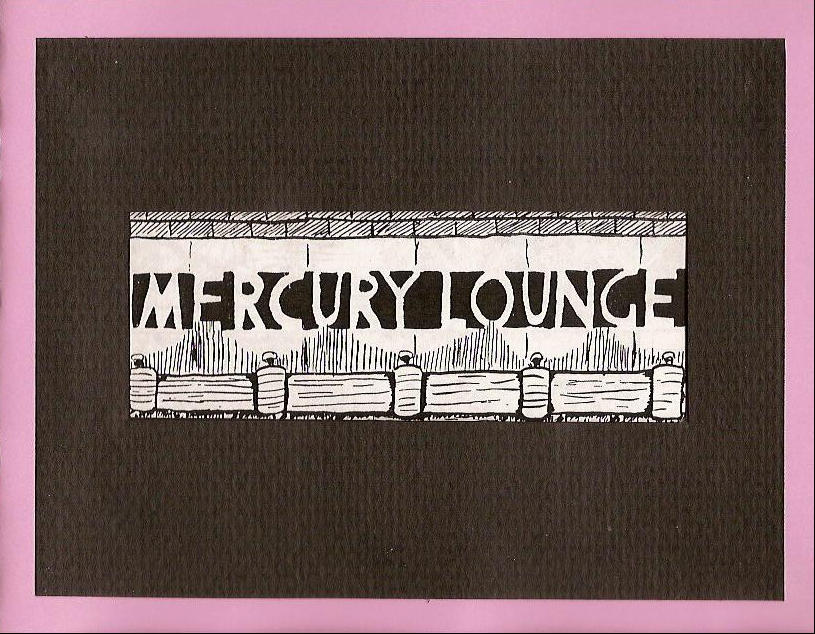
Also by Perez is the wordless mini-comic, Mercury Lounge. This one has a nice stiff cover made of pink paper with a black paper overlay. On the front cover, there’s a cutout with the title visible from the first page. This is a nice touch and it gives the mini a sturdier, well-crafted feel.
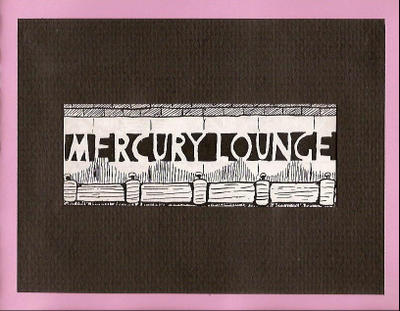
Inside, you’ll find a twenty-page tale of a night out at the club. Three friends, a girl and two guys, meet up in front of the Mercury Lounge and a fourth friend, a girl, joins them as they are exchanging greetings. One of the guys, Perez I’m assuming, sees the new girl and is immediately smitten. The rest of the evening is Perez trying to make some kind of contact with the girl at a loud show and then a loud bar afterwards. It’s a sweet story and he does a pretty good job of telling it without words. I like it when artists use a word balloon with symbols or pictures inside rather than words. Andy Runton’s Owly mini-comics used this to great effect, although I don’t recall any with a mug of beer in them. But anyway, Perez uses them to show the reader what’s happening a few times, most effectively when he shows a tiny guy with a guitar next to a calendar with Dec. 21st highlighted. I also liked when he hands the girl a copy of Carl is The Awesome. She loves it of course.
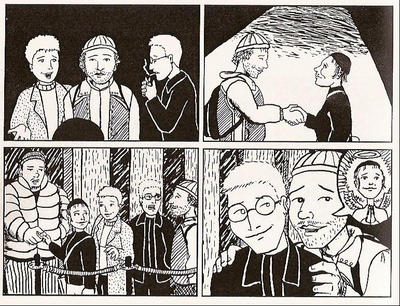
The art in Mercury Lounge is much more detailed than in the Carl collection. It’s obvious that Perez put much more time into the lines of the sidewalks, building facades and interior scenes. He creates an effective setting for his characters, even if they seem a bit stiff or awkwardly posed at times. I enjoyed Mercury Lounge and you can go here for a short preview. Like Carl, Mercury Lounge is $2. It’s also available at the website.
There are a lot of mini-comics that have found their way to the SIZE MATTERS offices, and I’m starting to make a dent in them. I need to be caught up before SPX though, so I’ll continue loading new minis every other day. Maybe every day if stuff keeps coming in.
Today is Marcos Perez day. Marcos sent in his Carl is The Awesome Vol. 1 and Mercury Lounge.
Carl is The Awesome Vol. 1 is pretty awesome for what it is, and that’s a collection of four short minis tucked into a little sleeve. It’s not just a mini-comic. It’s four mini comics – in a little sleeve!
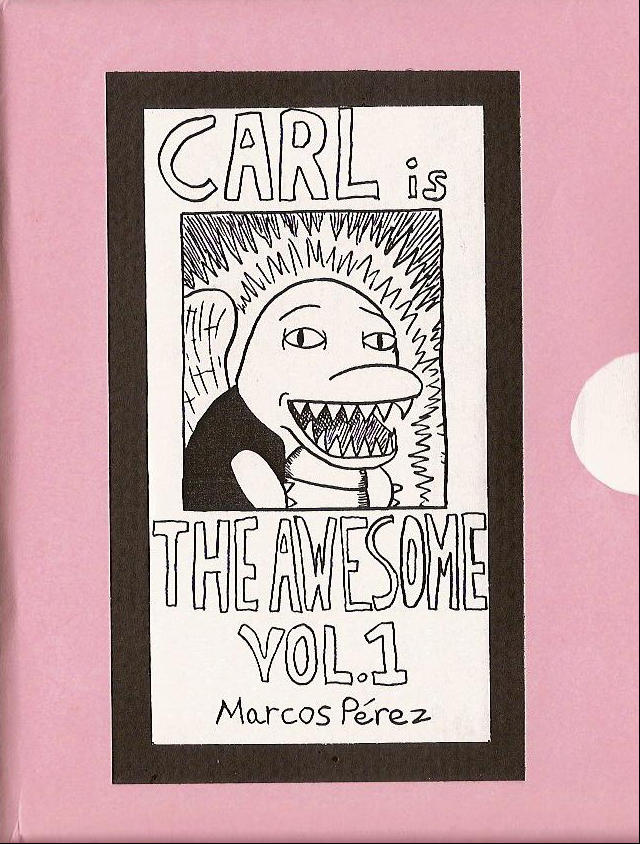
Carl is a dinosaur with a tail like a beaver. He’s about four feet tall, kind of pudgy and he is awesome. Or he thinks he’s awesome and he wants every one to know that he is. That’s the set-up. Issue one is an introduction of sorts to Carl. He says things like, “I have strong haunches and very sturdy teeth!!! My body is rugged like corduroy!” and “Ladies demand my sexuals!!” That’s Carl and that’s all you need to know to get started. In issue two, he introduces you to his band “The Supersicks,” and explains how they make their songs and all the rock star stuff they include on their rider.
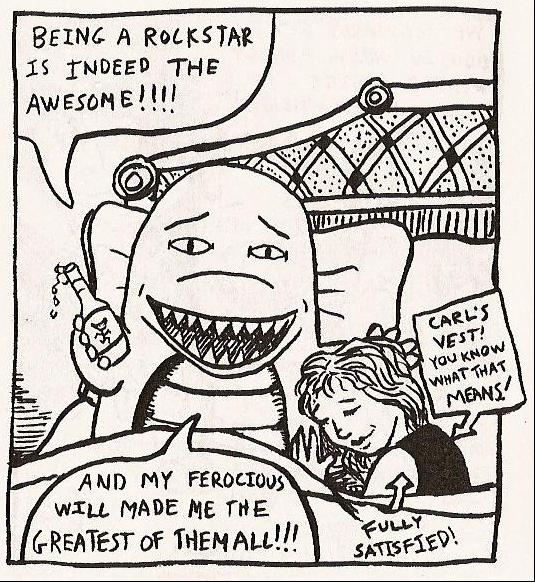
Issue three of Carl is The Awesome Vol. 1 is a informal lesson on how to score with the ladies. Carl explains how to make eye contact, select an opening line, how to navigate a conversation with a lady, how to kiss and when to use “C’mon!!” Issue four is the Carl runs for public office issue. Let’s put it this way, he’s an interesting debater.
Each of the four issues are eight, usually single panel pages, including the covers. The back cover counts as the last panel of the story. Carl is The Awesome Vol. 1 is $2 and you can get your copies at Cliff Face Comics. Perez is kind enough to have the first issue of Carl’s adventures on the website in color. GO check it out; you know you want to.
Also by Perez is the wordless mini-comic, Mercury Lounge. This one has a nice stiff cover made of pink paper with a black paper overlay. On the front cover, there’s a cutout with the title visible from the first page. This is a nice touch and it gives the mini a sturdier, well-crafted feel.
Inside, you’ll find a twenty-page tale of a night out at the club. Three friends, a girl and two guys, meet up in front of the Mercury Lounge and a fourth friend, a girl, joins them as they are exchanging greetings. One of the guys, Perez I’m assuming, sees the new girl and is immediately smitten. The rest of the evening is Perez trying to make some kind of contact with the girl at a loud show and then a loud bar afterwards. It’s a sweet story and he does a pretty good job of telling it without words. I like it when artists use a word balloon with symbols or pictures inside rather than words. Andy Runton’s Owly mini-comics used this to great effect, although I don’t recall any with a mug of beer in them. But anyway, Perez uses them to show the reader what’s happening a few times, most effectively when he shows a tiny guy with a guitar next to a calendar with Dec. 21st highlighted. I also liked when he hands the girl a copy of Carl is The Awesome. She loves it of course.

The art in Mercury Lounge is much more detailed than in the Carl collection. It’s obvious that Perez put much more time into the lines of the sidewalks, building facades and interior scenes. He creates an effective setting for his characters, even if they seem a bit stiff or awkwardly posed at times. I enjoyed Mercury Lounge and you can go here for a short preview. Like Carl, Mercury Lounge is $2. It’s also available at the website.
Tuesday, August 09, 2005
Top Five Desert Island Series
This won’t really be mini-comic related (until the end that is), but I wanted to answer a colleague’s request. So, I’ll hope you’ll indulge me until tomorrow. To celebrate his 100th column, Marc Mason has listed his Desert Island Comics over at Movie Poop Shoot. Look around the blogosphere and you’ll see some other bloggers doing the same in honor of Marc’s 100th column. Marc, congratulations; here are my own Top Five Desert Island Comics in alphabetical order.
Acme Novelty Library by Chris Ware
Repeated readings of these comics have unearthed little details that I must have glossed over the first time. With the complete series, you get Quimby, Jimmy Corrigan and other stories. Not the most uplifting stuff out there, I know, but they'd certainly help me pass an afternoon or two on the beach.
Darevevil Issue 1 to present
I knew I would pick one long running comics series for this list, I just didn’t know it would be Daredevil. There are some awful stretches of comics in this run, I’m sure, but I’ve probably only read half of them. But I’ve read all of Spider-Man, Fantastic Four, Batman and the other usual suspects. Besides in the DD run, there are the wonderful and gritty Frank Miller comics and, I know you’ll laugh, the Bendis/Maleev comics that I’ve enjoyed a great deal. There is the lengthy string of team-up issues with the Black Widow that took place somewhere around the century mark and the Born Again issues. I can do without Daredevil: Man Without Fear though, just give me the original series, warts and all. That should keep me busy for a long time.
Love & Rockets by Jaime and Gilbert Hernandez
This is a bit of a cheat really. Since I’ve read Palomar and Locas, I think of these as two distinct series. But I've still got all of the old magazine sized issues, so that would make for great reading. Since this is a game, I get to have the Love & Rockets issues from the current volume as well...
Starman by James Robinson and Tony Harris (and others later on)
Starman is my favorite super hero series and one of my favorite series of anything. It’s not a monumental or groundbreaking book, by any means. But it gets to the heart of what makes a super hero. Starman is first about the Knight family and second about Starman. It’s about what holds a family together and what drives a family apart. I liked Jack Knight a great deal as a character. I like the attention that James Robinson paid to the things that made Jack’s life so interesting. His love of old viewmaster reels, old LPs, old shirts and prints, and old cocktail shakers made Jack human; he wasn’t super human, but he was a hero, however reluctant. His love of the past was a way to connect him with his own family and his father’s past. Once he got past his initial revulsion of being Starman, he was able to appreciate where his father and his brother (very briefly) were before he went there himself.
Uncle Scrooge by Carl Barks
The original run of the Scrooge McDuck characters by Carl Barks has remained a favorite of mine since before I knew who Carl Barks was. As a kid I bought tons of Barks reprint comics without ever realizing why I liked his stories the best. Barks was a great storyteller and he knew how to make the art pop. His characters felt more alive and the stories themselves were more involving than those done by other Duck artists of the time.
Now, to bring this back to mini-comics, Five Desert Island Mini-Comic series:
Obviously King Cat Comics by John Porcellino
There are a bunch of his early issues that I haven't read, so that would be fun.
Supermonster by Kevin Huizenga I noticed that Graeme included these over on Fanboy Rampage.
Dirty Plotte by Julie Doucet. These were reprinted by Drawn & Quarterly thankfully.
Jennifer Daydreamer's complete set of mini-comics
Happy Town by Justin Madson
This won’t really be mini-comic related (until the end that is), but I wanted to answer a colleague’s request. So, I’ll hope you’ll indulge me until tomorrow. To celebrate his 100th column, Marc Mason has listed his Desert Island Comics over at Movie Poop Shoot. Look around the blogosphere and you’ll see some other bloggers doing the same in honor of Marc’s 100th column. Marc, congratulations; here are my own Top Five Desert Island Comics in alphabetical order.
Acme Novelty Library by Chris Ware
Repeated readings of these comics have unearthed little details that I must have glossed over the first time. With the complete series, you get Quimby, Jimmy Corrigan and other stories. Not the most uplifting stuff out there, I know, but they'd certainly help me pass an afternoon or two on the beach.
Darevevil Issue 1 to present
I knew I would pick one long running comics series for this list, I just didn’t know it would be Daredevil. There are some awful stretches of comics in this run, I’m sure, but I’ve probably only read half of them. But I’ve read all of Spider-Man, Fantastic Four, Batman and the other usual suspects. Besides in the DD run, there are the wonderful and gritty Frank Miller comics and, I know you’ll laugh, the Bendis/Maleev comics that I’ve enjoyed a great deal. There is the lengthy string of team-up issues with the Black Widow that took place somewhere around the century mark and the Born Again issues. I can do without Daredevil: Man Without Fear though, just give me the original series, warts and all. That should keep me busy for a long time.
Love & Rockets by Jaime and Gilbert Hernandez
This is a bit of a cheat really. Since I’ve read Palomar and Locas, I think of these as two distinct series. But I've still got all of the old magazine sized issues, so that would make for great reading. Since this is a game, I get to have the Love & Rockets issues from the current volume as well...
Starman by James Robinson and Tony Harris (and others later on)
Starman is my favorite super hero series and one of my favorite series of anything. It’s not a monumental or groundbreaking book, by any means. But it gets to the heart of what makes a super hero. Starman is first about the Knight family and second about Starman. It’s about what holds a family together and what drives a family apart. I liked Jack Knight a great deal as a character. I like the attention that James Robinson paid to the things that made Jack’s life so interesting. His love of old viewmaster reels, old LPs, old shirts and prints, and old cocktail shakers made Jack human; he wasn’t super human, but he was a hero, however reluctant. His love of the past was a way to connect him with his own family and his father’s past. Once he got past his initial revulsion of being Starman, he was able to appreciate where his father and his brother (very briefly) were before he went there himself.
Uncle Scrooge by Carl Barks
The original run of the Scrooge McDuck characters by Carl Barks has remained a favorite of mine since before I knew who Carl Barks was. As a kid I bought tons of Barks reprint comics without ever realizing why I liked his stories the best. Barks was a great storyteller and he knew how to make the art pop. His characters felt more alive and the stories themselves were more involving than those done by other Duck artists of the time.
Now, to bring this back to mini-comics, Five Desert Island Mini-Comic series:
Obviously King Cat Comics by John Porcellino
There are a bunch of his early issues that I haven't read, so that would be fun.
Supermonster by Kevin Huizenga I noticed that Graeme included these over on Fanboy Rampage.
Dirty Plotte by Julie Doucet. These were reprinted by Drawn & Quarterly thankfully.
Jennifer Daydreamer's complete set of mini-comics
Happy Town by Justin Madson
Sunday, August 07, 2005
John Oak Dalton's Volunteers
The first issue of John Oak Dalton’s Volunteers seems a bit off. The art is very simplified and the dialogue is clunky. The words almost seem to be programmed or selected by a shoddily programmed supercomputer. But then John explains the making of the issue - the dialogue in Volunteers was cut and pasted, using a pre-determined criteria for selecting text and issues, from cast off comics. Aha! That’s why it felt a bit off.
As John writes:
“I was thinking about ‘found art’-making art out of whatever flotsam and jetsam happens to be lying around. Thus, all of the dialogue in VOLUNTEERS #1 was chosen at random from old comic books I plucked out of an overflowing box, with the following caveats: the comic book must be at least 15 years old, and preferable an obscure title or one no longer in print. I wrote each one out on a post-it, and kept rearranging and re-arranging them until they made sense…”
In issues 2 through 5 of Volunteers, John drops the cut and paste angle and makes up his own stories, characters and dialogue (in issues four and five, his brother Eric shares the credits). It’s obvious immediately. The new Volunteers reads like the fun stories from decades ago, filtered through today’s sensibilities. Again, the art is simple, but it’s not without charm. What John’s work lacks in artistic depth, it makes up for in sheer whimsy.
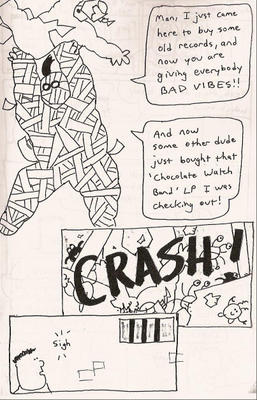
In the first issue, a black female super hero named R.O.O.K. comes from the future to team up with The Volunteers (this incarnation is Moon Belt ThriceMan, Visor Virago, and Red-Hand Sure Shot). They meet, she struggles with a world much different from her own, they face a terrorist threat and then ROOK sees herself in the present, even though she is clearly from the future. She wonders if she should stop her “present self” and ask what’s going on, but then she starts to get all confused. The last page and a half is eighteen panels of John zooming in and out on ROOK’s face as she tries to puzzle through her unique problem. From off panel a teammate calls, “Rook?”
Then, right on cue, end of issue.
Each issue is 12 pages, so John structures it as introduction to new incarnation of the team, conflict, new team members, and then a messy resolution that leads into the next issue. Issue three is the funniest of the these issues as it introduces a character called “White Miracle.” Miracle is misquoted in the press as he tries to explain why he’s called White Miracle. A media frenzy ensues and he is forced to resign from the team.
Issue four’s incarnation of The Volunteers is Lickety-Split (super-speed), Timepiece, The Lug, Terrormancer, and The Fightin’ Mummy. Lickety-Split gets a lot of flak for his name, rightfully so, I guess and he also goes to jail for trying to steal some Pokey-Man figures from an unnamed Two Day Collectibles Show. In issue Five, The Grip, Quick-Draw, Volt Viper, and Gravitrix join Timepiece and Lickety-Split, who have just been released from jail. The gang gets a new lair, and a guy named Devil-Mask comes by with two pots of chili, one of them vegan.
John’s comics are entertaining. They’re short and a little primitive art-wise, but there’s a lot to like in these comics. I’m not sure how much he charges for an issue, as there’s no price, but you reach him at johnoakdalton@hotmail.com. He’s also got a blog where he “weighs in on b-movies, comic books, role-playing games, and more geek culture. The ninth circle of nerd-dom, if you will.”
The first issue of John Oak Dalton’s Volunteers seems a bit off. The art is very simplified and the dialogue is clunky. The words almost seem to be programmed or selected by a shoddily programmed supercomputer. But then John explains the making of the issue - the dialogue in Volunteers was cut and pasted, using a pre-determined criteria for selecting text and issues, from cast off comics. Aha! That’s why it felt a bit off.
As John writes:
“I was thinking about ‘found art’-making art out of whatever flotsam and jetsam happens to be lying around. Thus, all of the dialogue in VOLUNTEERS #1 was chosen at random from old comic books I plucked out of an overflowing box, with the following caveats: the comic book must be at least 15 years old, and preferable an obscure title or one no longer in print. I wrote each one out on a post-it, and kept rearranging and re-arranging them until they made sense…”
In issues 2 through 5 of Volunteers, John drops the cut and paste angle and makes up his own stories, characters and dialogue (in issues four and five, his brother Eric shares the credits). It’s obvious immediately. The new Volunteers reads like the fun stories from decades ago, filtered through today’s sensibilities. Again, the art is simple, but it’s not without charm. What John’s work lacks in artistic depth, it makes up for in sheer whimsy.
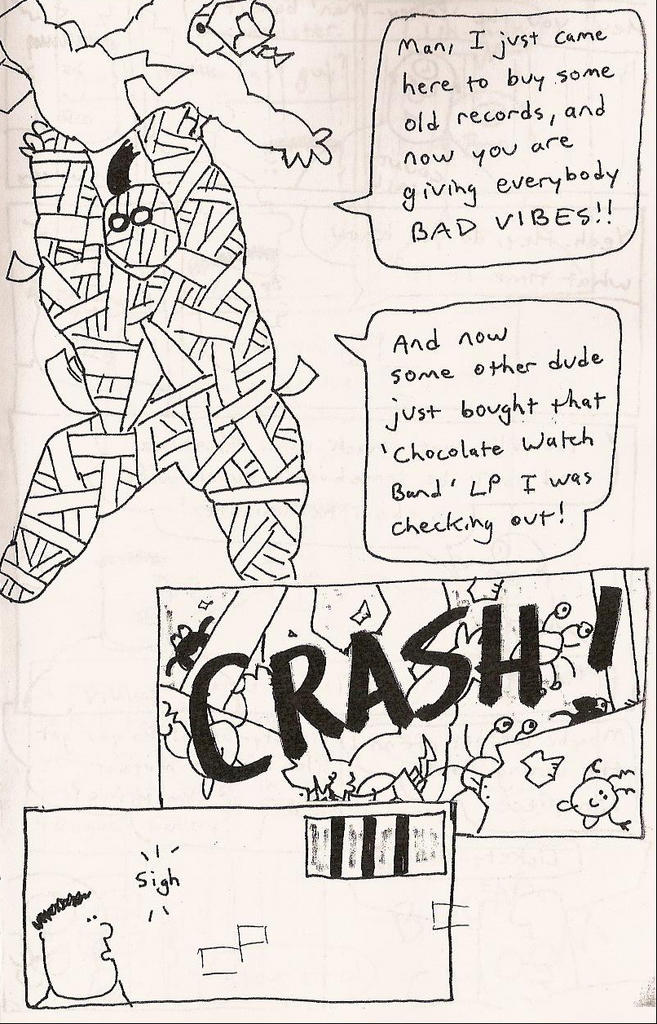
In the first issue, a black female super hero named R.O.O.K. comes from the future to team up with The Volunteers (this incarnation is Moon Belt ThriceMan, Visor Virago, and Red-Hand Sure Shot). They meet, she struggles with a world much different from her own, they face a terrorist threat and then ROOK sees herself in the present, even though she is clearly from the future. She wonders if she should stop her “present self” and ask what’s going on, but then she starts to get all confused. The last page and a half is eighteen panels of John zooming in and out on ROOK’s face as she tries to puzzle through her unique problem. From off panel a teammate calls, “Rook?”
Then, right on cue, end of issue.
Each issue is 12 pages, so John structures it as introduction to new incarnation of the team, conflict, new team members, and then a messy resolution that leads into the next issue. Issue three is the funniest of the these issues as it introduces a character called “White Miracle.” Miracle is misquoted in the press as he tries to explain why he’s called White Miracle. A media frenzy ensues and he is forced to resign from the team.
Issue four’s incarnation of The Volunteers is Lickety-Split (super-speed), Timepiece, The Lug, Terrormancer, and The Fightin’ Mummy. Lickety-Split gets a lot of flak for his name, rightfully so, I guess and he also goes to jail for trying to steal some Pokey-Man figures from an unnamed Two Day Collectibles Show. In issue Five, The Grip, Quick-Draw, Volt Viper, and Gravitrix join Timepiece and Lickety-Split, who have just been released from jail. The gang gets a new lair, and a guy named Devil-Mask comes by with two pots of chili, one of them vegan.
John’s comics are entertaining. They’re short and a little primitive art-wise, but there’s a lot to like in these comics. I’m not sure how much he charges for an issue, as there’s no price, but you reach him at johnoakdalton@hotmail.com. He’s also got a blog where he “weighs in on b-movies, comic books, role-playing games, and more geek culture. The ninth circle of nerd-dom, if you will.”
Friday, August 05, 2005
John Porcellino at Newsarama?
File this under… I can’t believe I’m linking to Newsarama from here. But I am and with good reason.
John Porcellino interviewed at Newsarama. They even have one of my favorite King Cat pages up.

The John Porcellino interview with Zak Sally in TCJ #241 was one of my favorite interviews in the Journal. I actually had a lot of trouble finding that issue locally and I wasn’t able to get to Chicago Comics that month for some reason. So, I checked it out of an unnamed library and never returned it.
Found at Fanboy Rampage, thanks Graeme.
File this under… I can’t believe I’m linking to Newsarama from here. But I am and with good reason.
John Porcellino interviewed at Newsarama. They even have one of my favorite King Cat pages up.

The John Porcellino interview with Zak Sally in TCJ #241 was one of my favorite interviews in the Journal. I actually had a lot of trouble finding that issue locally and I wasn’t able to get to Chicago Comics that month for some reason. So, I checked it out of an unnamed library and never returned it.
Found at Fanboy Rampage, thanks Graeme.
Wednesday, August 03, 2005
Don't be alarmed, but there's a monster on top of your bugglegum machine.
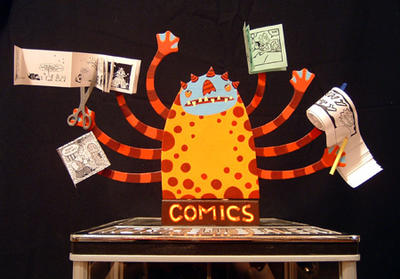
As if you needed another reason to go to SPX this September... Over at the Little House news section they've posted pictures of their mini-comic display for SPX. It's the gumball machine from last year's show - with a twsit. I'll let Eleanor explain:
Hey Folks! If any of you were at SPX or Fluke last year you might have seen the gumball machine filled with minicomics that our gang had going on. Well, this year we'll have newer, better, and more comics by more folks! Contributers to the machine should include me, Drew, David, Joey, and Chris, and maybe Nate, Adam, Michele and Hunter. Here's the new revamped machine, complete with it's own little guardian monster displaying th' wares for all to see.
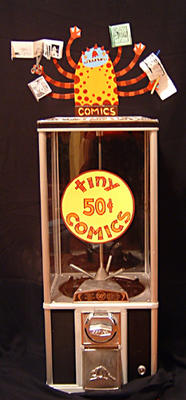
Tiny comics for fifty cents. Irresistable.
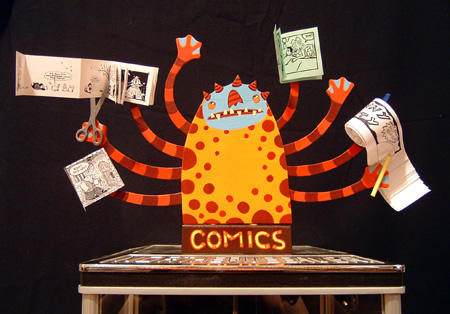
As if you needed another reason to go to SPX this September... Over at the Little House news section they've posted pictures of their mini-comic display for SPX. It's the gumball machine from last year's show - with a twsit. I'll let Eleanor explain:
Hey Folks! If any of you were at SPX or Fluke last year you might have seen the gumball machine filled with minicomics that our gang had going on. Well, this year we'll have newer, better, and more comics by more folks! Contributers to the machine should include me, Drew, David, Joey, and Chris, and maybe Nate, Adam, Michele and Hunter. Here's the new revamped machine, complete with it's own little guardian monster displaying th' wares for all to see.

Tiny comics for fifty cents. Irresistable.
Tuesday, August 02, 2005
Bare Foot Riot by Martin Cendreda
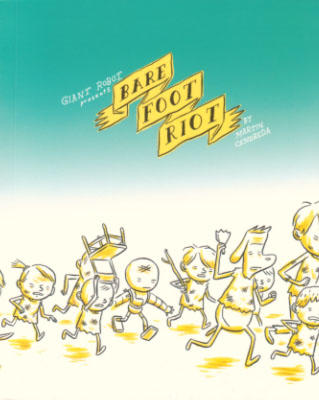
Over at my weekly Comic World News gig, I posted a review this morning of Martin Cendreda's new mini-sketchbook from Giant Robot. I thought readers here might be interested in the sketchbook, since Martin has so recently made the switch from mini-comics. Here's a piece of the review:
Bare Foot Riot is the largest sampling of Cendreda’s work that I’ve seen and it’s also the most eclectic. There’s everything in here from straight gags, very loose sketches of scenery and buildings, and longer comedy strips. He riffs on advertising, super hero costumes, pop culture figures and toys, and each sketch has that familiar and pleasant feel that I’ve come to expect when I look at his work. But there’s something else. When you’re accustomed to a cartoonist’s obvious flair for cartooning, you may forget that they can actually draw real world stuff as well. His gag cartoons have the stripped down utility where every line is essential, in other words, there are no wasted lines. Cendreda’s figures in his comics and gags are all big heads and gangly limbs; his characters look comical regardless of the situation, which is where much of the humor in his work lies. In Riot, however, you’re introduced to another side of the artist. There are serious studies of chairs, life drawings, and accomplished animal sketches that show the same confidence as the line he uses for his gags. It’s interesting to see Cendreda work in so many different styles in one book...
There’s plenty here that pleases me, because it’s done in a familiar vein as the artists other work, but there’s a lot here that challenges what I expected to see when I purchased the book. This is more multi-faceted than anything else I’ve seen from Cendreda and it’s priced very attractively. It’s twelve dollars for 98 pages of sketches, several pages in color, and it’s in a mini-comic size.
Here's the full review.
Here's the link to the Giant Robot store page featuring Bare Foot Riot.

Over at my weekly Comic World News gig, I posted a review this morning of Martin Cendreda's new mini-sketchbook from Giant Robot. I thought readers here might be interested in the sketchbook, since Martin has so recently made the switch from mini-comics. Here's a piece of the review:
Bare Foot Riot is the largest sampling of Cendreda’s work that I’ve seen and it’s also the most eclectic. There’s everything in here from straight gags, very loose sketches of scenery and buildings, and longer comedy strips. He riffs on advertising, super hero costumes, pop culture figures and toys, and each sketch has that familiar and pleasant feel that I’ve come to expect when I look at his work. But there’s something else. When you’re accustomed to a cartoonist’s obvious flair for cartooning, you may forget that they can actually draw real world stuff as well. His gag cartoons have the stripped down utility where every line is essential, in other words, there are no wasted lines. Cendreda’s figures in his comics and gags are all big heads and gangly limbs; his characters look comical regardless of the situation, which is where much of the humor in his work lies. In Riot, however, you’re introduced to another side of the artist. There are serious studies of chairs, life drawings, and accomplished animal sketches that show the same confidence as the line he uses for his gags. It’s interesting to see Cendreda work in so many different styles in one book...
There’s plenty here that pleases me, because it’s done in a familiar vein as the artists other work, but there’s a lot here that challenges what I expected to see when I purchased the book. This is more multi-faceted than anything else I’ve seen from Cendreda and it’s priced very attractively. It’s twelve dollars for 98 pages of sketches, several pages in color, and it’s in a mini-comic size.
Here's the full review.
Here's the link to the Giant Robot store page featuring Bare Foot Riot.
Subscribe to:
Posts (Atom)


 Posts
Posts

